The short answer
Start with the job you want to do, then buy the tools it needs. For basic checks, a tire pressure gauge, a work light and a code reader go a long way. For wheel and lifting jobs, buy a torque wrench that reaches your truck’s lug nut spec, a floor jack that can reach the axle, and tall stands rated for your truck. Buy quality where safety depends on it.
Start with the job you want to do, then buy the tools it needs. A full wall of tools you never use helps less than a few good ones you know how to use.
Here is the list I would build a truck owner’s garage around, grouped by the kind of job. I am naming tool types, not brands. A heavy-duty truck changes a few of the buying rules, so I point those out as we go.
Basic checks
1.A tire pressure gauge and a portable inflator
Check your tire pressure when the tires are cold, and set it to the number on the door jamb label, not the number on the sidewall. A good gauge is cheap. A portable inflator that plugs into the truck means you can fix low pressure at home or on the road. Check that the gauge and the inflator can reach the pressure on your door label. Many car-sized ones cannot.
2.A good work light
You cannot fix what you cannot see. A rechargeable LED work light with a magnet or hook frees up both hands. A headlamp is a great second light for looking under the dash or into a wheel well.
3.An OBD2 code reader
When the check engine light comes on, a code reader tells you where to start looking. It does not tell you what part to buy. A basic reader may show only current codes. A scan tool that also shows pending and permanent codes, and can scan the other modules, is worth the extra money if you want the full picture.
Wheel and lifting jobs
4.A socket set, ratchets and a breaker bar
Most jobs on a truck start here. Get a set with standard and deep sockets in the sizes your truck uses, a few extensions, and a breaker bar for stuck bolts. Lug nuts on a heavy-duty truck are tight, and a breaker bar saves your ratchet.
5.A torque wrench that reaches your lug nut spec
Lug nuts, hitch bolts and drain plugs all have a torque specification for a reason. On a Super Duty, the lug nut torque is higher than many car-sized torque wrenches can reach, and Ford changed it over the years. The 2017 owner’s manual lists 165 lb.ft, and the 2026 manual lists 150 lb.ft. Use the number for your model year, and buy a torque wrench whose range covers it with room to spare. Both manuals also say to retighten the lug nuts within 100 miles after a wheel has been off.
Pro tip
Store a click-type torque wrench at its lowest setting, and do not use it as a breaker bar. It is a measuring tool.
6.A floor jack that can reach the axle
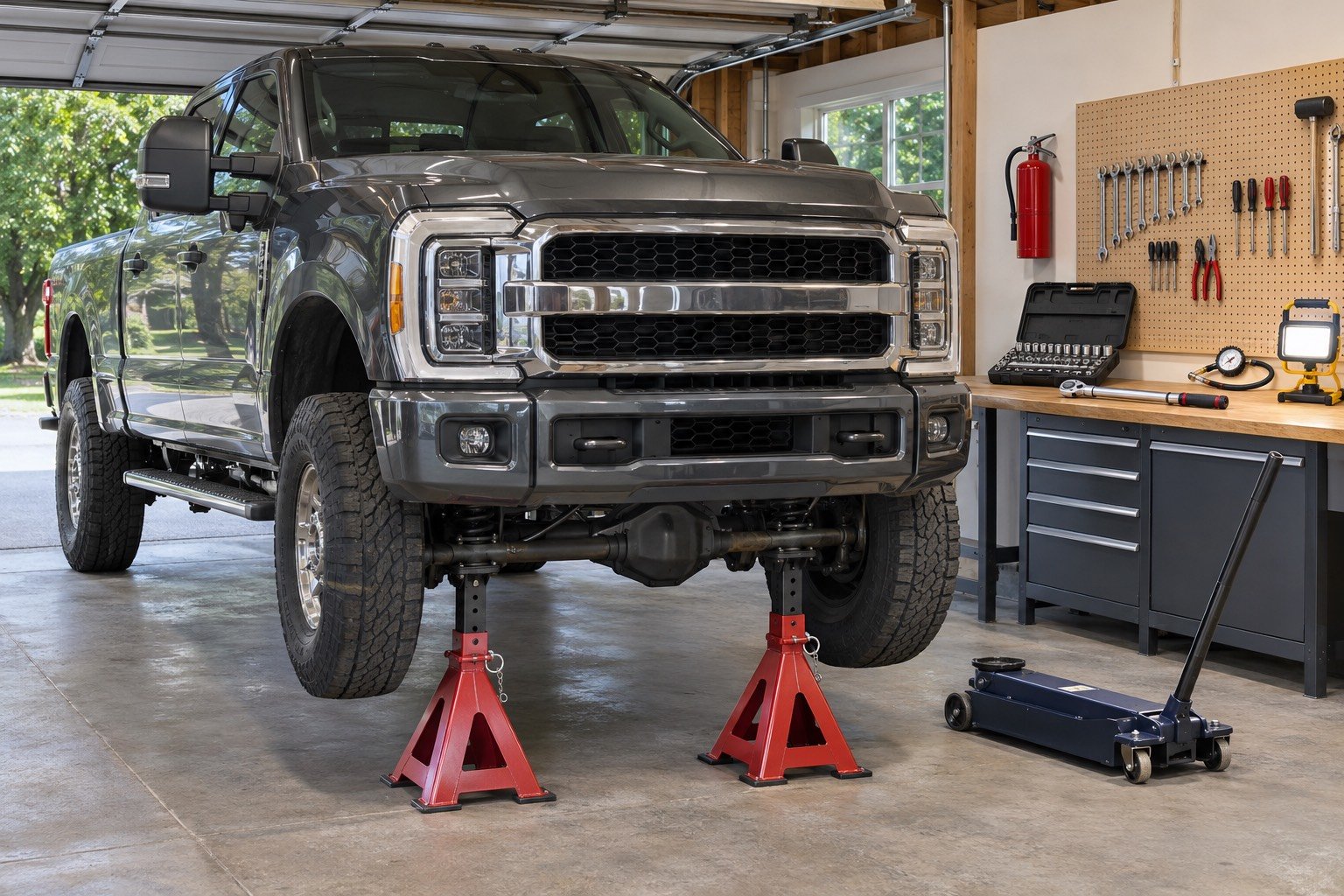
A 4×4 Super Duty sits high. A low-profile car jack may not reach the axle at all, and a jack at the end of its travel is not a safe jack. Look for a heavy-duty jack with enough lift height to reach your truck’s lift points, and a rating above the weight on the axle you are lifting. The front and rear axle weight ratings (GAWR) are printed on the label in the driver’s door jamb. That is a good number to buy against.
7.Tall jack stands, rated for your truck
Never work under a vehicle held up only by a jack. Buy a pair of tall stands that reach your truck’s lift points without being fully extended, with the pair rated above the axle weight you will put on them. Put them under the lift points your owner’s manual shows, on flat, solid ground, and chock the wheels that stay on the ground.
This is the one place I would never save money.
Hand tools
- Combination wrenches in the sizes your truck uses
- Screwdrivers, flat and Phillips, plus a set of Torx bits
- Pliers: needle nose, slip joint and locking pliers
- A dead blow hammer
- A utility knife and a set of picks
Fluids and cleanup
An oil drain pan big enough for a diesel oil change, a funnel set, shop towels, nitrile gloves, and a container for used oil. Many auto parts stores take used oil for recycling. Call first. Never pour it on the ground or into a drain.
Safety gear, next to the job
Keep safety glasses and gloves with the tools you use them with, not in a drawer across the garage. Hang an ABC-rated fire extinguisher near the door, where you can reach it, not behind the thing that is burning. An ABC unit covers ordinary materials, flammable liquids and electrical fires, which is what a garage can have.
If you tow, add these
- A tongue weight scale, so you know your number before every trip
- Wheel chocks and leveling blocks
- A lug wrench that fits both the truck and the trailer
- A circuit tester for the trailer plug and lights
- Spare bulbs and fuses for the truck and the trailer
Your first job with these tools
Start with a simple, useful job: check and set the tire pressures with your gauge and inflator. When you are ready for a wheel job, use the socket set, breaker bar and torque wrench to check the lug nut torque against the value for your model year. You learn how each tool feels before you need it for something bigger.
Before any job, lay out the tools its instructions call for, and check that each one is there and in good condition.
What I would wait on
Air tools, an impact wrench, specialty pullers and a big rolling toolbox are all nice. Buy them when a real job needs them.
Know when to stop
Some jobs need a lift, special tools or training: brakes on a heavy truck, anything on the high-pressure fuel system of a modern diesel, air bags and many electrical repairs. If a job involves safety systems or you are not sure, take it to a professional. Knowing when to hand it off is part of being good at this.