
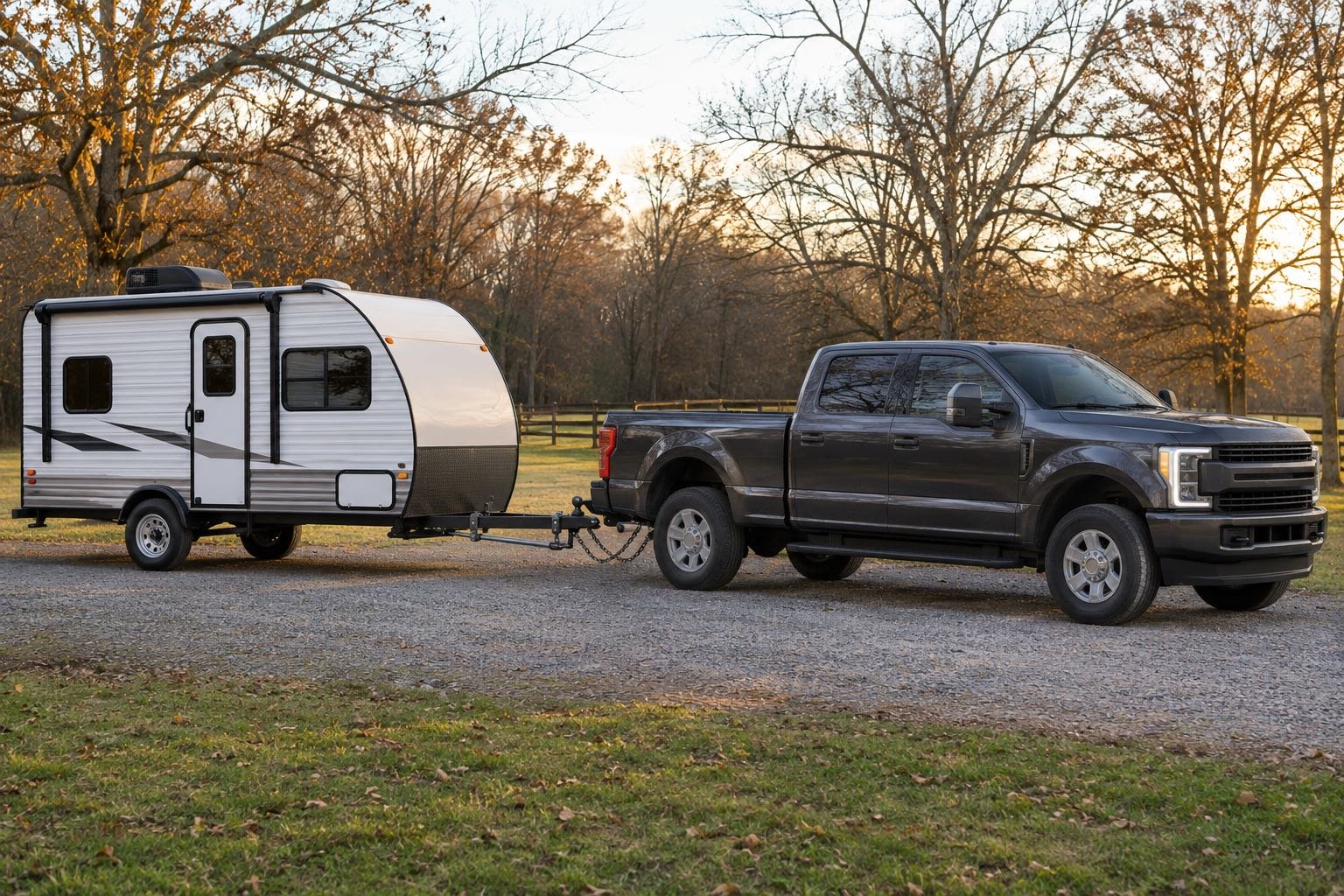
The short answer
Know your truck’s ratings, weigh the loaded rig, and record your starting measurements. Then set the hitch head height and spring bar tension to restore front axle load to the target for your truck. Ford’s 2027 towing guide recommends restoring 50 percent of the front axle load. Test drive and recheck before the real trip.
A weight distribution hitch is one of the best things you can add to a Super Duty towing setup. It is also easy to set up wrong and never notice. A good hitch with a bad setup still tows badly.
Here is the order I would work in. Your hitch maker’s instructions are the final word on the hardware. This guide is about the order of the steps and what you are trying to achieve.
What the hitch actually does
When you drop a trailer tongue on the hitch ball, the back of the truck goes down and the front comes up. That takes weight off your front tires, which steer and do a big share of the braking. A weight distribution hitch uses spring bars to move some of that weight back to the front axle and to the trailer axles.
Many of these hitches also include sway control. Sway control helps, but it is not a fix for a trailer that is loaded wrong.
1.Know your ratings before you hitch
Look at four places before you buy or adjust anything:
- The receiver label. It lists two ratings: one for weight carrying (no spring bars) and one for weight distributing. Use the one that matches how you tow, and never exceed its tongue weight. On the 2027 Super Duty, Ford lists the same number for both: an F-250 is rated for 22,000 lb with 2,200 lb of tongue weight, and an F-350 single rear wheel for 25,000 lb with 2,500 lb. Check your own truck’s label, because ratings change by year and model.
- The payload sticker on the driver’s door jamb. Tongue weight, passengers and gear all count against payload.
- GAWR, the gross axle weight rating for the front and rear axles, on the door label. The rear axle carries most of the tongue weight.
- GCWR, the gross combined weight rating for truck plus trailer, in your owner’s manual or Ford’s towing guide.
2.Weigh the rig, loaded
Load the trailer the way you will really travel, with water, gear and propane. Ford’s rule for conventional trailers is a tongue weight of 10 to 15 percent of the total trailer weight.
A truck scale gives you real numbers. Weigh in three passes: the truck alone, loaded for the trip; the truck and trailer hitched with the spring bars off; and the truck and trailer with the spring bars on. Compare the front axle numbers across the passes and you can see how much load the hitch puts back on the front axle.
Pro tip
The trailer you weigh empty at the dealer lot is not the trailer you tow. Weigh it loaded for a trip.
3.Measure the truck before you hitch up
Park on level ground. With the truck loaded the way you travel, but with no trailer, measure from the center of each wheel hub straight up to the edge of the fender. Write down the front and rear numbers. These are your starting measurements.
4.Set the hitch head height and tilt
Level the trailer with its jack and measure the height of the coupler. Set the hitch head on the shank so the trailer will ride level, or the way your hitch maker says. Most shanks have several holes for this. Set the head tilt the way the instructions describe, because the tilt changes how much the spring bars can do.
Torque the hitch ball and every head bolt to the values in the hitch instructions. Write the date on a piece of tape on the shank so you remember when you checked them.
5.Hitch up and tension the spring bars
Couple the trailer, latch and pin the coupler, cross the safety chains, and connect the breakaway cable and the electrical plug.
Now take the second measurement. With the spring bars off and the trailer jack fully retracted so the whole tongue rests on the truck, measure the front and rear fender heights again and write them down. This is the hitched measurement.
Then raise the tongue a little with the trailer jack, attach the spring bars as your hitch’s instructions describe, and retract the jack fully again so it carries no weight at all.
6.Measure a third time and compare to the target
With the bars on, measure the front and rear fender heights a third time. Compare the front measurement with the target for your truck and record it before you make another change.
Ford’s 2027 towing guide recommends 50 percent front axle load restoration when you use load bars. The 2017 owner’s manual describes the same target by height: set the front fender height halfway between the unhitched and hitched measurements. Both methods aim at about the same result. Use the one in the guide or manual for your model year.
If the front is still too high, add spring bar tension the way your hitch allows. If you have gone past the target, back it off. Do not crank the bars as hard as possible to make the truck sit level. Too much tension can take load off the rear axle and cause its own handling problems.
7.Test drive and recheck
Drive a short loop at low speed first, then at road speed somewhere safe. Pay attention to how the steering feels, how the trailer follows, and how the brakes feel.
After the first trip, check the bolts again and look over the spring bars and brackets. Hitches settle in.
Do not forget the trailer brakes
A weight distribution hitch helps the truck handle the load. It does not stop the trailer. Most travel trailers have electric brakes, and your truck needs a brake controller set up for them. Check whether your truck has a built-in trailer brake controller.
Set the controller gain with the trailer loaded, on a dry, empty road at low speed. Also test the breakaway switch in the driveway before every trip, the way the trailer’s manual describes. It is the part that stops the trailer if it ever comes loose. Put the pin back right away.
Common setup mistakes
- Setting the hitch up with an empty trailer, then loading it full for the trip.
- Checking only the tow rating and forgetting payload and the receiver label.
- Using sway control to cover for a trailer with too little tongue weight.
- Never rechecking bolt torque after the first trip.
When to get help
If the trailer sways, follow the sway steps in your owner’s manual, then pull over safely. If anything else feels wrong on the road, like light steering or a porpoising ride, pull over safely and check the setup before you go on. A good RV dealer or hitch shop can set the system up with you and show you what to look for.